Skip to content
Academic and General Training

IELTS tutor for Academic and General Training, one learner at a time

IELTS tutor lessons, from tutors who have coached hundreds of candidates, are built around the band each of your four skills has to reach, at home or online, at a time that fits around college, a job or shift work.

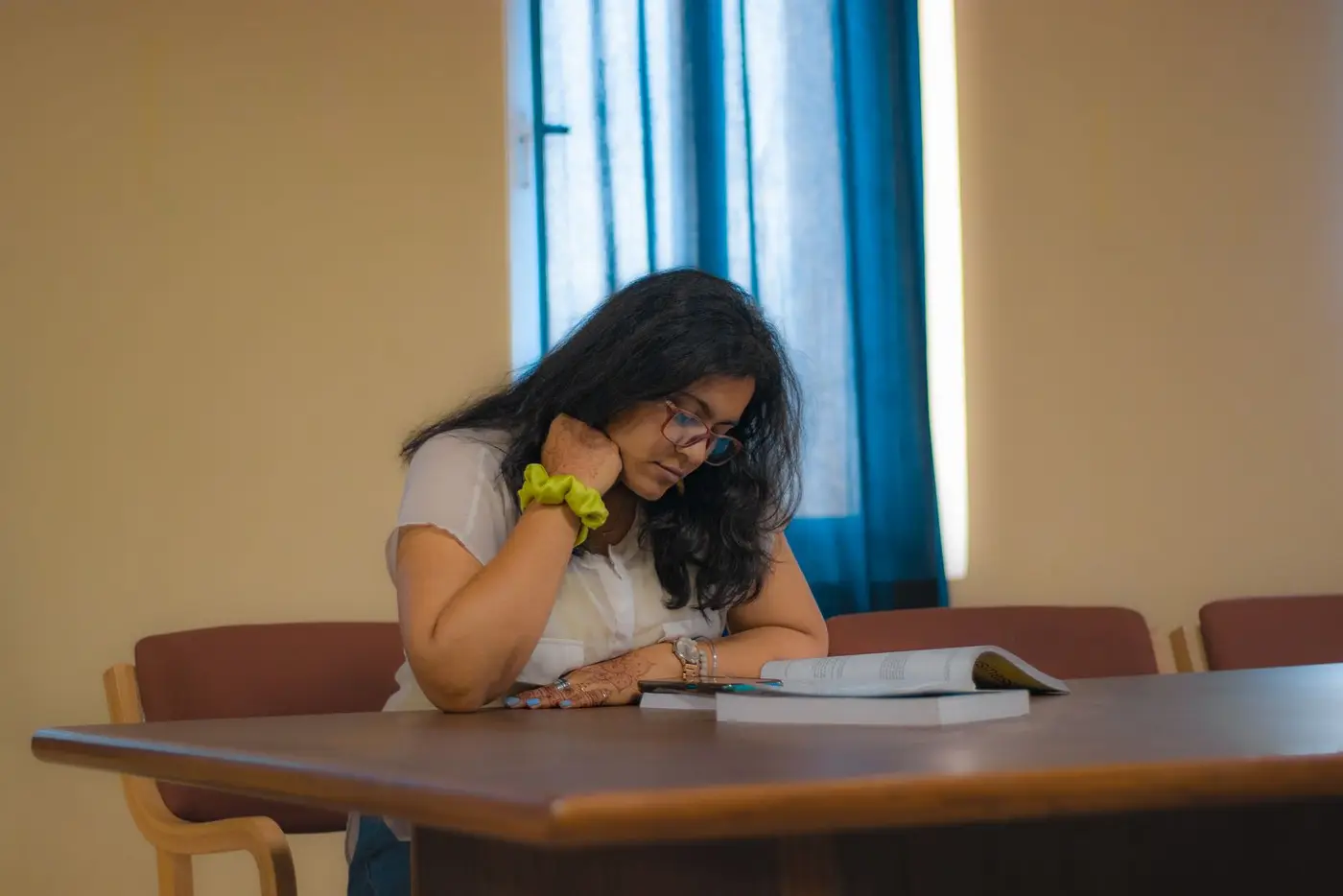
A young woman reading her study notes at a table

4.8 out of 5153 reviews

Full Guide

What is

IELTS

IELTS is the International English Language Testing System, the test universities, employers and immigration authorities ask for when they want evidence that you can study, work or live in English. It runs in four parts: Listening, Reading, Writing and Speaking. The whole paper takes 2 hours and 45 minutes, and the Speaking test is a face to face interview with a certificated examiner, taken on the same day as the rest or within seven days of it. Your result comes back as a band from 0 to 9 for each skill and one overall band, and IELTS recommends that a result be treated as valid for two years.

Key Points

  1. Two papers share the name: Academic for degree study and professional registration, General Training for migration and for study below degree level.
  2. Listening and Speaking are identical in both papers. Reading and Writing are where the two part company.
  3. Listening and Reading carry 40 questions each, one mark per answer, and a spelling slip costs that mark.
  4. Writing Task 2 contributes twice as much as Task 1 to the Writing band, so the essay carries the section.
  5. The overall band is the average of the four skills, rounded to the nearest half band.
Format Options

Two ways to sit down with an IELTS tutor

Some learners want a person across the table with their essay in hand. Others are working shifts and need the lesson to come to them. Both run the same way: one tutor, one learner, and a plan tied to your test date.

  1. Duration: Usually 60 to 90 minutes, as agreed with your tutor

    IELTS lessons at your home

    The tutor comes to your address with practice material, marks Task 1 and Task 2 in front of you so you can see where the marks went, and runs the Speaking parts across the table, which is the closest thing at home to the interview waiting at the test centre.

    • Writing marked on paper, with the corrections visible
    • Speaking Parts 1, 2 and 3 practised out loud every lesson
    • Listening played once only, the way the real recording runs
  2. Duration: Usually 45 to 90 minutes, agreed with the tutor

    IELTS lessons over video

    Lessons run over video with the screen shared for reading passages and essay feedback. This also rehearses the computer-delivered paper, where you read on screen and type your answers, and it keeps the lesson possible on a night shift or from a small town.

    • Typing practice for the computer-delivered paper
    • Essays returned with comments against the four marking criteria
    • Speaking mocks timed to the real 11 to 14 minutes
Progression Path

What each band on the scale means

IELTS describes every band in plain words, and a target becomes realistic once you know which description you are standing in. The wording and the raw marks below come from the official nine-band scale.

  1. Band 5

    Modest user

    A partial command of the language, coping with overall meaning in most situations, with plenty of mistakes along the way. IELTS puts this at roughly 16 marks out of 40 in Listening and 15 in Academic Reading.

    Subjects

    Listening: about 16 of 40Academic Reading: about 15 of 40

    Focus Areas

    • Repair the grammar that blurs meaning
    • Learn the question types before any speed work
    • Read something in English every single day
  2. Band 6

    Competent user

    An effective command of the language despite some inaccuracies and misunderstandings, with fairly complex language handled well in familiar situations. Roughly 23 marks out of 40 in both Listening and Academic Reading.

    Subjects

    Listening: about 23 of 40Academic Reading: about 23 of 40

    Focus Areas

    • Finish Task 2 with a conclusion, inside 40 minutes
    • Stop losing Listening answers to plurals and spelling
    • Speak for two minutes without drying up
  3. Band 7

    Good user

    An operational command with occasional inaccuracies and misunderstandings, and complex language handled well. Roughly 30 marks out of 40 in Listening and in Academic Reading. Many degree courses and professional bodies pitch their requirement around here.

    Subjects

    Listening: about 30 of 40Academic Reading: about 30 of 40

    Focus Areas

    • Vocabulary range chosen for accuracy in each sentence
    • True, False or Not Given answered from the text alone
    • Part 3 answers that explain and speculate
  4. Bands 8 and 9

    Very good and expert user

    Band 8 is a fully operational command with rare unsystematic slips; Band 9 is full command, accurate, appropriate and fluent. Band 8 sits near 35 marks out of 40 in Listening and in Academic Reading, and IELTS recognises 8.5 and above as C2 on the CEFR.

    Subjects

    Listening: about 35 of 40Academic Reading: about 35 of 40

    Focus Areas

    • Precision under time, in every one of the four skills
    • Idiom used naturally in Speaking Parts 2 and 3
    • Full mocks sat end to end, with no break
Learning Phases

How IELTS preparation is sequenced

Seven phases, in the order a tutor usually takes them. Where you begin depends on your baseline and on how many weeks stand between today and the date you have booked.

Every fact about the paper below follows the official IELTS test format pages, read on 23 September 2026.

  1. Choosing the paper and fixing the target

    5 topics

    Academic or General Training, computer or paper, and the exact score the university, employer or immigration authority is asking for. Each receiving organisation sets its own requirement, so the number is copied from their page and written at the top of the plan.

    • Academic against General Training
    • IELTS for UKVI and when a visa route needs it
    • The minimum in each skill, alongside the overall band
    • A full timed baseline sitting
    • Test date, booking window and how many weeks are left
  2. Accuracy before speed

    5 topics

    Marks in Listening and Reading go to spelling and to plural endings long before they go to difficulty. This phase repairs the small mechanics that the answer sheet punishes, and the sentence patterns that a Writing examiner counts as range.

    • Spelling of dates, names, numbers and addresses
    • Singular and plural in one-word answers
    • Articles, prepositions and word forms
    • Complex sentences that stay clear
    • Collocation worth more than long words
  3. Question types, one at a time

    6 topics

    Reading and Listening reward a reader who recognises the machinery of a question before reading the passage. Each type is taught on its own, slowly, then folded into a timed section once the method holds.

    • True, False or Not Given
    • Matching headings to paragraphs
    • Map, plan and diagram labelling
    • Form, note, table and sentence completion
    • Multiple choice that asks for two answers
    • Short answer questions with a word limit
  4. Writing Task 1, in both its forms

    6 topics

    Academic Task 1 describes one or more graphs, charts or tables, or a diagram of a process, in at least 150 words of academic or neutral style. General Training Task 1 is a letter of at least 150 words, personal, semi-formal or formal depending on who receives it. Both are given about 20 minutes.

    • Reading a chart before writing a word
    • Overview sentence that states the main movement
    • Comparison language and grading a change
    • Process diagrams in sequence
    • The three bullet points of a General Training letter
    • Choosing the register a letter needs
  5. Writing Task 2, the essay that counts double

    6 topics

    At least 250 words in about 40 minutes on a point of view, an argument or a problem, in academic or neutral style, supported by relevant examples. It is marked on task response, coherence and cohesion, lexical resource, and grammatical range and accuracy.

    • Reading the question for what it actually asks
    • Planning in four minutes, writing in thirty
    • Paragraphs that carry one idea each
    • Examples that support the argument
    • Conclusions written before the time runs out
    • Continuous prose, since bullet points are penalised
  6. Speaking Parts 1, 2 and 3

    6 topics

    Eleven to fourteen minutes with a certificated examiner: everyday questions on home, work, studies and interests, then a task card with one minute for notes and about two minutes to talk, then a general discussion that opens the same topic wider.

    • Part 1 answers that go beyond a sentence
    • Using the minute of notes on the task card
    • Two minutes of speech with a shape to it
    • Part 3 answers that explain and speculate
    • Pronunciation that stays intelligible
    • Repair phrases when a word will not come
  7. Full mocks, band arithmetic and test day

    5 topics

    Two hours and forty five minutes with no break is a skill of its own. This phase adds the stamina, the rounding rules that decide an overall band, and the decision about whether a One Skill Retake is worth booking inside the 60-day window.

    • Full papers sat end to end, under time
    • Averaging four skills and rounding to the nearest half band
    • Computer or paper, and how fast results come back
    • Reading the Test Report Form
    • When one skill is worth retaking
Who It Is For

Who sits IELTS, and which paper they need

The same test serves a school leaver, a nurse and a family planning to move, and each of them walks in with a different paper booked and a different score to hit.

School leavers and graduates applying abroad

Applications to universities overseas usually ask for IELTS Academic, and the offer letter names both an overall band and a minimum for each skill. The Academic Reading passages come from books, journals and newspapers, so the preparation doubles as reading practice for the course itself.

Recommended:

IELTS AcademicStart well before the application deadlineCheck the minimum in each skill

Working adults planning to migrate

IELTS General Training is the paper for people moving to an English-speaking country or studying below degree level. Its Reading works through notices, timetables, job descriptions and contracts, and Task 1 asks for a letter, which is closer to the writing most jobs actually demand.

Recommended:

IELTS General TrainingEvening or weekend lessonsLetter writing in three registers

Professionals seeking registration

Nurses, doctors, engineers and accountants applying to a professional body abroad are usually asked for IELTS Academic, often with a floor under every one of the four skills. Speaking and Writing tend to be the two that decide it, and both improve with a person listening.

Recommended:

IELTS AcademicSpeaking mock every lessonWriting marked against all four criteria

Repeat candidates short in one skill

Plenty of people clear three skills and fall half a band short in the fourth. If the original test was taken on computer, One Skill Retake lets you sit that single section again within 60 days, once per original test, which makes targeted work on one skill worth far more than a full second attempt.

Recommended:

One skill, taught in depthShort plan inside the 60-day windowFull mock before rebooking
Four skills, one band

The four parts of the IELTS paper

Each skill is marked on its own and the four are then averaged, so the skill you quietly avoid is usually the one that decides your overall band.

2 hours 45 minutes

Total test time

40 questions each

Listening and Reading

11 to 14 minutes

Speaking

0 to 9

Band scale

Listening

L

Four recorded parts and forty questions, played once only. Parts 1 and 2 stay in everyday life, first a conversation between two speakers, then one speaker alone. Parts 3 and 4 move into study, a discussion and then a talk on an academic subject.

Core Topics

  • โ€ขForm, note and table completion
  • โ€ขMap and plan labelling
  • โ€ขBritish, Australian, New Zealand and North American accents
  • โ€ขSpelling of names and numbers
  • โ€ขFollowing a speaker who corrects himself

Common Sticking Points

The recording moves on whether or not you are ready, and the answer you are still writing belongs to a question two lines back. A missing plural or a misspelt street name costs the whole mark.

Share of the overall band

A quarter of the overall band

Listening, Reading and Writing are sat in one sitting with no break between them. The Speaking test is taken on the same day, or within seven days before or after the other three.

A Peek at the Material

A page out of an IELTS lesson

Three small pieces of the work: the words that grade a change, one Task 1 sentence built from its parts, and a Reading item of the kind that quietly costs people a band.

Writing Task 1 and one Reading item

Words that grade a change

rose sharplyclimbed steadilyedged upsurged
fell steeplydeclined graduallydippedslumped
levelled offfluctuatedpeakedheld steady

One Task 1 sentence, three parts

  1. Fridge ownershipclimbed steadilyfrom 1995 to 2005Fridge ownership climbed steadily from 1995 to 2005.
  2. Bus usefell steeplyafter 2010Bus use fell steeply after 2010.
  3. Both lineslevelled offin the final yearBoth lines levelled off in the final year.

True, False or Not Given

Passage: the library opens at 9 a.m. on weekdays and stays shut on Sunday.

Question: Statement: the library is open on Saturday morning. True, False or Not Given?

Answer: **Not Given.** The passage gives weekday hours and rules out Sunday. Saturday is never mentioned, and a statement the passage never touches can never be False.

Written for this page. Work on official sample papers too, since the questions that matter are the ones the examiner writes.

Where IELTS is lost

Five places candidates lose half a band

None of these is about English ability. They are habits, and a tutor who watches you work can name yours in the first two lessons.

Challenge

Answering True, False or Not Given from general knowledge

A common sticking point

Root cause

The statement sounds sensible, the world agrees with it, and the pen moves to True before the passage has been checked. Not Given feels like an admission of failure, so candidates avoid choosing it, and a set of three answers collapses together.

What helps

A tutor makes you underline the line in the passage that decides each answer, and mark Not Given the moment no such line exists. Practice runs slowly at first, with the reason for every answer said out loud, before the clock is put back on.

Challenge

Writing Task 2 short, or answering half the question

A common sticking point

Root cause

Task 2 asks for at least 250 words in about 40 minutes and it counts twice as much as Task 1 towards the Writing band. Many candidates spend thirty minutes polishing the chart description, then write an essay that stops mid-argument or answers only one half of a two-part question.

What helps

The order is reversed in practice: Task 2 first, timed at forty minutes, until 250 words with a conclusion is routine. The question gets broken into its parts in writing before a single paragraph is planned, so nothing is left unanswered.

Challenge

Losing Listening marks to spelling and plurals

A common sticking point

Root cause

The recording plays once. Candidates hear the answer correctly, then write Wednesday with one d, or put ticket where the sentence needs tickets. Each one of those is a full mark gone, and marks in Listening convert straight into the band.

What helps

Dictation of dates, names, numbers and addresses becomes a five-minute warm-up in every lesson. The tutor also trains the habit of reading the question stem for grammar, so the answer is written in the form the sentence around it demands.

Challenge

Going blank in the two-minute long turn

A common sticking point

Root cause

Part 2 gives a task card, one minute to prepare and around two minutes to speak. Under pressure the minute is spent staring at the card or writing full sentences that cannot be read aloud, and the talk runs dry after forty seconds.

What helps

The minute gets a fixed shape: four or five note words, one per bullet on the card, plus a closing thought. The tutor then times you at two minutes, every lesson, until running out of things to say stops happening.

Challenge

Chasing the overall band and missing the per-skill floor

A common sticking point

Root cause

The overall band is the average of the four skills, rounded to the nearest half. A candidate with 7.5, 7.5, 7 and 5.5 has an overall 7, and an institution that also requires 6.5 in every skill will still turn the application down over Writing.

What helps

The requirement gets copied from the institution's own page in the first lesson, both the overall figure and the per-skill floor. The weakest skill then takes the largest share of lesson time, which is rarely the skill the candidate enjoys most.

Marks in Listening and Reading are counted out of 40 and converted to a band, so a handful of careless answers moves a whole band.

How It Works

How IELTS tuition is arranged with Edutara

Four steps from the first message to the first lesson. Nothing here depends on a batch starting or on a seat being free in a classroom across town.

  1. 01

    You tell us the paper and the score

    Academic or General Training, the band each skill has to reach, the date you plan to sit, and whether you want the tutor at your home or over video. The requirement comes from the university, employer or authority you are applying to.

  2. 02

    Edutara looks for a tutor who teaches it

    IELTS tutoring is a narrower skill than teaching English. The search is for someone who knows both papers, marks Writing against the four criteria, and can run a Speaking mock that feels like the real eleven to fourteen minutes.

  3. 03

    One lesson tells you about the tutor

    You sit one lesson before committing to anything. It usually ends with a written sample and a recorded answer, which tells you as much about the tutor as it tells the tutor about your English. Need a different tutor at any point in your preparation? Edutara makes the change free.

  4. 04

    Lessons follow your own week

    Timings are agreed between you and the tutor, which matters when the test date is fixed and your free hours are not. Edutara sets the fee from the paper, the schedule and your city and bills it by invoice, and it pays the tutor for every lesson.

What an IELTS tutor has to bring

A tutor here marks your work against the same four criteria an examiner uses, and can say in plain words what would move a piece of writing from one band to the next.

What we look for in a tutor
  • A degree, with English as the language of study or of daily work
  • Working knowledge of both papers: Academic Task 1 with its charts, and the General Training letter
  • Able to mark Writing on task response, coherence and cohesion, lexical resource and grammar
  • Comfortable running a timed Speaking mock, task card and the minute of notes included
  • Serving school teachers stay out of private tuition under Section 28 of the RTE Act, 2009, so tutors here are graduates, professionals and retired teachers
  • Willing to teach on the learner's schedule, including early mornings and weekends

How a tutor works through IELTS with you

Marking before teaching

The first lesson usually ends with a piece of writing and a recorded answer, because a band is far easier to raise once you can see which of the four criteria is holding it down. Guessing at the weakness wastes the weeks you have.

One skill at a time, then the whole paper

Reading and Listening answer to question-type drills. Writing and Speaking answer to repetition with feedback. Full mocks come later, once each skill has somewhere to stand, so that by then a mock measures stamina.

Speaking out loud from the first lesson

Speaking is the skill learners postpone, and it is the one that needs another person most. Every lesson carries some talking under time, so that eleven to fourteen minutes with a stranger stops being the frightening part of the day.

Home tutor, coaching batch or preparing alone

Each of the three prepares people successfully. What changes is how much attention your own writing and your own speaking receive in a given week.

What you get
Edutara
Coaching batchPreparing alone
Every lesson is one to one
Someone hears you speak and corrects you
Your own essays come back marked by a person
The plan follows your own test date
You choose the time and the place of each lesson
At home or online

Lessons at your address or over video

  1. Online tuition

    Anywhere in India, over video

    Online lessons suit anyone on shifts, anyone in a town where IELTS tutors are thin on the ground, and anyone sitting the computer-delivered paper, since reading on a screen and typing an essay is exactly what the test day will ask for.

    Screen sharing for reading passages and essay feedback
    Typing practice for the computer-delivered paper
    Speaking mocks you can listen back to

    Timezone: IST (UTC+5:30)

  2. Home tuition

    At your own address

    Tell us the locality and Edutara looks for a tutor who can reach it at a time that suits you. Where nobody nearby teaches IELTS, the same lessons run over video and cover the same ground, with the same tutor.

    Available cities:

FAQ

Questions people ask before booking IELTS

The answers below follow the official IELTS pages, read on 23 September 2026. Anything that depends on a university or a visa route is set by that organisation, so check it on their own page.

Should I book IELTS Academic or General Training?
Academic is for people planning to study at degree level in English and for professionals seeking registration; its Reading and Writing use the kind of material a university sets. General Training is for people moving to an English-speaking country such as Australia, Canada, New Zealand or the UK, or studying below degree level; its Reading covers notices, timetables and workplace documents, and Task 1 is a letter. The Listening and Speaking papers are identical in both. If a visa route or an institution has named the paper it wants, that naming settles it.
Can I retake only the one skill I fell short in?
Often, yes. IELTS One Skill Retake lets you sit one section again, Listening, Reading, Writing or Speaking, if your original test was taken on computer at a centre that offers it. You must sit the retake within 60 days of the full test, and you can take it once per original test. You then receive a new Test Report Form carrying the retaken score alongside your three original scores, and you choose which form to send. Some organisations accept it and some do not, so confirm with the university or authority before you book.
How long does an IELTS result stay valid?
IELTS recommends that a Test Report Form be treated as valid for two years after the test date, because language ability changes with use. Some organisations accept an older result if you can show you have kept your English in active use, and others hold firmly to the two years. Plan the test date backwards from the deadline that matters. Sitting very early means the result may expire before an admission cycle or a visa decision is finished.
How many weeks of preparation does IELTS need?
It depends entirely on the distance between where your English stands today and the band you have been asked for, which is why a tutor starts with a full timed sitting. Someone comfortable in English who needs to learn the paper may need a handful of weeks on question types and timing. Someone who needs to lift the language itself needs months, and no honest tutor will tell you otherwise. Book the test only once a full mock has landed near your target. The date is easier to move than the result.
How is the overall band score worked out?
You get a band from 0 to 9 for Listening, Reading, Writing and Speaking. The overall band is the average of those four, rounded to the nearest half band. An average ending in .25 rounds up to the next half band, and one ending in .75 rounds up to the next whole band. So 6.5, 5, 7 and 6.5 average 6.25 and are reported as an overall 6.5. Watch the per-skill numbers as closely as the overall one. Many institutions set a floor under every skill, and a strong average does not lift a weak Writing score over it.
Computer or paper: which one should I book?
The content, the timing and the band scale are the same, and Speaking is a face to face interview with an examiner either way. What differs is the experience and the wait. On computer you read on screen and type your Writing, and results are available 1 to 5 days after the test. On paper you write by hand and results come 13 days after the test. One Skill Retake is only available to candidates who took the test on computer. In India, IDP runs IELTS on computer several times a day through the week, and the paper test a few times a month.
What band will my university or visa route ask for?
Each organisation sets its own requirement, and there is no single number to quote. For a UK Student visa, GOV.UK states that courses at degree level and above require English equivalent to CEFR level B2, and courses below degree level require B1, proved in reading, writing, speaking and listening. IELTS maps onto the CEFR loosely. Its own guidance for organisations says band 5 sits at B1 or B2, a C1 threshold falls between 6.5 and 7, and 8.5 and above is recognised as C2. Take the exact number from the page of the university, employer or authority you are applying to, and note the per-skill minimum as well.
Do I need a tutor at all, or can I prepare on my own?
Listening and Reading can be pushed a long way alone, because official practice material comes with an answer key and you can mark yourself honestly. Writing and Speaking are where self-study stalls: nobody can tell you that your essay sits at band 6 for lexical resource, or that a pronunciation habit is costing you a half band, from inside your own head. That is where one-to-one time earns its place. A tutor marks your own essays, hears your own Speaking, and spends the whole hour on your weakest skill.
Complete Guide

A full guide to preparing for IELTS from India

  1. Which IELTS to book, and why the answer is rarely yours to guess

    Start at the other end. Open the page of the university, the professional body or the visa route you are applying to, and read what it asks for: the paper, the overall band, and the minimum in each of the four skills. That page settles everything else in your plan.

    IELTS Academic is the paper for degree-level study and professional registration. Its Reading takes three long texts from books, journals, magazines and newspapers, and Task 1 asks you to describe a graph, chart, table or process. IELTS General Training is the paper for migration to countries such as Australia, Canada, New Zealand and the UK, and for study below degree level. Its Reading moves through notices, advertisements and timetables, then workplace material such as job descriptions, contracts and training documents, then one longer general-interest text. Task 1 there is a letter.

    There is also IELTS for UKVI, which is the same test administered to meet UK Visas and Immigration requirements for certain visa routes, and IELTS Life Skills, which tests only Speaking and Listening for particular UK immigration purposes. Booking the wrong one costs you the whole fee and the whole waiting period, so read the requirement twice before you pay.

    Practical Tips

    1. Copy the requirement from the institution's own page into a note, both the overall band and the per-skill floor.
    2. Check whether the route names IELTS for UKVI, because a standard test will not satisfy it.
    3. If two institutions ask for different bands, plan for the higher one from the first lesson.
    4. Confirm that the centre offers One Skill Retake before deciding between computer and paper.
  2. How the bands are actually worked out

    IELTS reports on a nine-band scale. Band 9 is an expert user with full command of the language, band 8 a very good user with rare unsystematic slips, band 7 a good user with occasional inaccuracies, band 6 a competent user with an effective command despite some mistakes, and band 5 a modest user with partial command. Below that, bands 4 to 1 describe increasingly limited use, and band 0 means the test was not attempted.

    Listening and Reading are counted in raw marks: 40 questions, one mark each, converted to a band. IELTS publishes indicative thresholds, and they are a useful reality check. In Listening, roughly 16 marks gives band 5, 23 gives band 6, 30 gives band 7 and 35 gives band 8. Academic Reading is close behind at about 15, 23, 30 and 35.

    Writing and Speaking are judged by trained examiners against four published criteria each. Writing is marked on task achievement or task response, coherence and cohesion, lexical resource, and grammatical range and accuracy, with Task 2 contributing twice as much as Task 1. Speaking is marked on fluency and coherence, lexical resource, grammatical range and accuracy, and pronunciation.

    The overall band is the average of the four, rounded to the nearest half. This is where people are caught out: an average of 6.25 is reported as 6.5, an average of 6.75 becomes 7, and an institution with a floor under every skill will still read your lowest number first.
  3. Shaping the weeks before your test date

    Preparation collapses when every study session is a practice test. A full paper takes two hours and forty five minutes and tells you the same thing three times in a row; what moves a band is the slower work between the mocks.

    A workable shape begins with one full timed sitting to find the baseline, then several weeks where each skill is taken apart. Question types are learnt one at a time, without the clock, until the method is automatic. Writing moves from planning to full essays, with every piece marked against the four criteria and rewritten once. Speaking gets time in every single lesson, because it is the skill that decays fastest when it is postponed.

    Only then do full mocks return, spaced out, sat end to end without a break, at the hour of day your real test is booked for. A mock is worth the afternoon it costs only when the marking afterwards is careful, and when the errors go into a list you actually revisit.

    Practical Tips

    1. Keep an error log for Listening and Reading, sorted by the reason you lost the mark.
    2. Rewrite one marked essay each week, line by line, before starting a fresh one.
    3. Read something in English every day, and read some of it aloud for pronunciation.
    4. Sit at least two full papers end to end before the real thing, with no break between sections.
    5. Give the largest share of lesson time to the skill you enjoy least.
  4. Test day, your results and the 60-day retake window

    Listening, Reading and Writing are taken in one sitting with no break in between. Speaking may fall on the same day or up to seven days before or after, and that gap is worth planning around: it gives you one more week of talking practice, or one more week to worry, depending on how you use it.

    Results arrive 1 to 5 days after a computer-delivered test and 13 days after a paper test. Your Test Report Form shows a band for each skill and the overall band. Read it carefully before deciding anything, because the shape of the four numbers tells you whether a single section let you down or whether the level itself needs more time.

    If you took the test on computer and fell short in exactly one skill, One Skill Retake may be the cheaper road back. It must be sat within 60 days of the full test, may be taken once per original test, and produces a new Test Report Form carrying the new score with your three original ones. Confirm first that the organisation you are applying to accepts it.

    Mistakes & Solutions

    Booking the test date before a full mock has ever been sat
    Sit one complete timed paper first and convert it into bands. Book the date once that number is within reach of the target, and keep the booking window in mind since popular slots fill early.
    Treating the gap before the Speaking test as a holiday
    Keep talking every day in that gap, even for fifteen minutes. Speaking loses fluency faster than any other skill, and the examiner meets you on whichever day the centre has scheduled.
    Assuming a One Skill Retake will be accepted everywhere
    Ask the university, employer or authority in writing whether they accept a Test Report Form produced by One Skill Retake, before you spend the sixty days and the fee on it.
    Sitting the test far earlier than needed, to be safe
    Count back from the deadline instead. IELTS recommends treating a result as valid for two years, and an early result can expire in the middle of an admission or visa process.

Getting started

Tell us your paper and your target band

  • Academic and General Training
  • At your home or over video
  • Free tutor change before test day
  • Fees set by Edutara at enrolment

Say whether you need Academic or General Training, the score you are aiming at, and the date you plan to sit. Edutara then looks for a tutor who teaches that paper.

Find an IELTS tutor

You keep a tutor only while it works, and a new one is free anytime.

Find an IELTS tutor