Skip to content
CBSE, ISC and state boards

Class 12 chemistry tuition for the board paper and the lab

Class 12 chemistry tuition with one of Edutara's hundreds of chemistry tutors, at home or online: unit by unit through the ten your board examines, the Nernst numericals side by side, and the titration and salt analysis ready early.

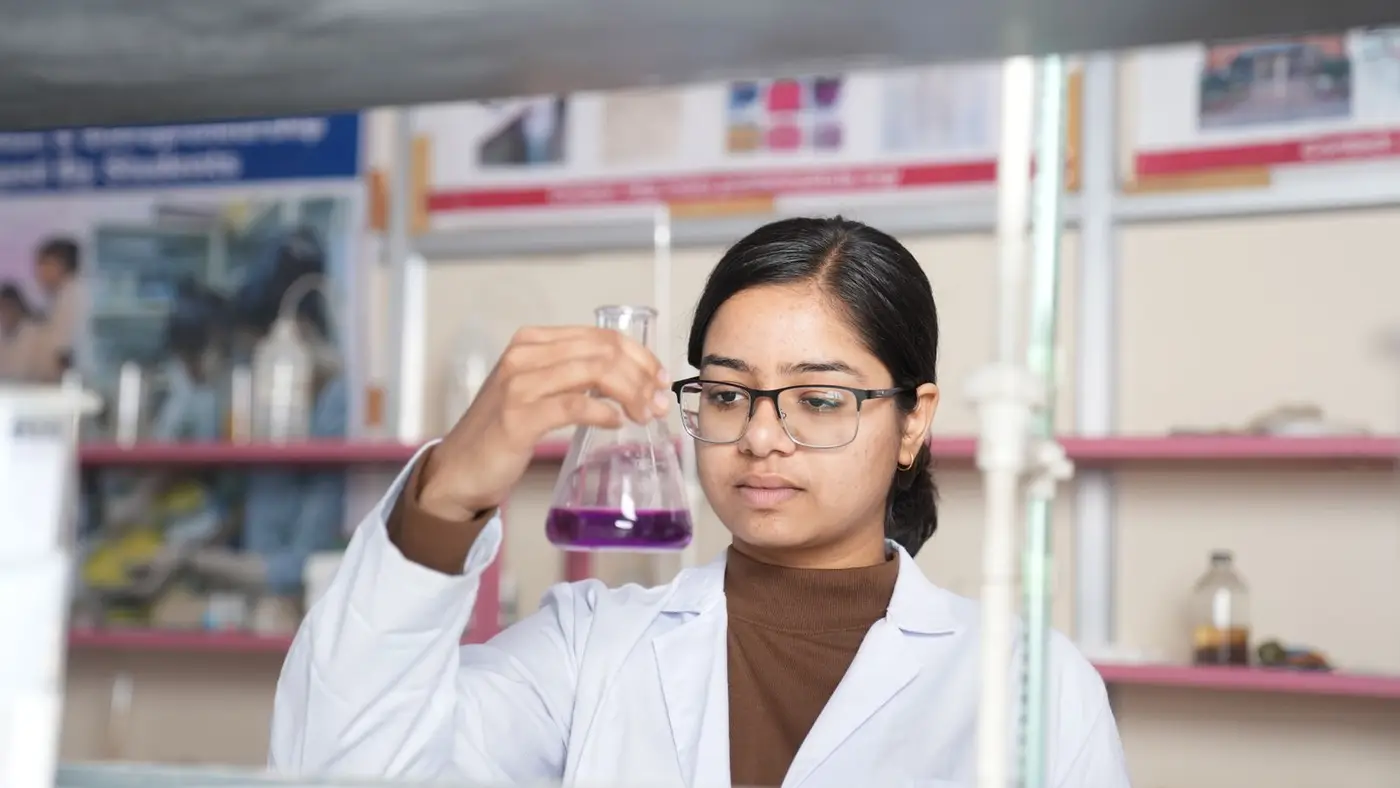
A student in a lab coat examining a coloured solution in a conical flask

4.7 out of 5278 reviews

Program Definition

What is
Class 12 chemistry?

Class 12 is the year chemistry splits into three branches, and each asks for a different kind of work. For 2026-27 CBSE gives the theory paper 70 marks across ten units: Solutions 7, Electrochemistry 9 and Chemical Kinetics 7 on the physical side; d- and f-Block Elements 7 and Coordination Compounds 7 on the inorganic side; and 33 marks spread over Haloalkanes and Haloarenes, Alcohols, Phenols and Ethers, Aldehydes, Ketones and Carboxylic Acids, Amines and Biomolecules. The practical carries the other 30. ISC sets the same three branches at 25, 14 and 31 marks for the Year 2027 paper, so a student who moves between the two systems is reading the same chapters with the scales shifted.

Key Points

  • Electrochemistry is the heaviest single unit in the CBSE paper for 2026-27, at 9 marks out of 70.
  • Organic chemistry holds 33 of those 70 marks, so a shaky mechanism costs more than a shaky numerical.
  • The CBSE practical is 30 marks: volumetric analysis 8, salt analysis 8, a content based experiment 6, project 4, class record and viva 4.
  • ISC weights the branches its own way for Year 2027: Physical 25, Inorganic 14, Organic 31.
  • Surface chemistry, polymers, isolation of elements and everyday chemistry are taught in 2026-27 and assessed by CBSE only formatively.
Format Options

Two ways a chemistry lesson can run

Chemistry needs a surface to scribble arrows on and a bench to stand at. Both formats handle the first; the school laboratory handles the second. The choice usually comes down to who is within reach and which evening is free.

  1. Duration: About 90 minutes, agreed with the tutor

    Chemistry tuition at home

    The tutor comes to the learner's house. That suits the long organic sittings, where half a page of arrows has to stay in view while the next step is worked out, and it suits a student who talks more freely with someone sitting at the same table.

    • Mechanisms worked out on paper, side by side
    • Past board questions marked in front of the student
    • A fixed evening slot that the session can be built around
  2. Duration: 60 to 90 minutes, agreed with the tutor

    Online chemistry tuition

    Lessons over video with a shared whiteboard. This is often the only way to reach a tutor who knows a particular board or has carried students through the NEET chemistry list, and a structure drawn live is easier to follow than one already printed.

    • A shared board for structures, equations and rough work
    • Reaches a tutor outside the learner's own city
    • Short doubt sittings before a unit test or a practical
Learning Roadmap

How a Class 12 chemistry year is usually built

Boards examine ten units, and they are not equal in weight or in the kind of effort they ask for. A tutor plans the year around that, and around the practical that runs underneath all of it.

  1. Physical chemistry

    23 of the 70 CBSE theory marks

    Solutions, Electrochemistry and Chemical Kinetics. These are the units where marks are gained and lost in arithmetic, and they reward a student who starts early, because the algebra behind colligative properties and the Nernst equation takes a few weeks to feel ordinary.

    Subjects

    SolutionsElectrochemistryChemical Kinetics

    Focus Areas

    • Colligative properties and the van't Hoff factor
    • Nernst equation worked without a calculator
    • Integrated rate equations and half-life
  2. Inorganic chemistry

    14 of the 70 CBSE theory marks

    The d- and f-Block Elements and Coordination Compounds. Two units, both short to read and easy to underestimate, because the questions ask for reasons: why a colour appears, why an oxidation state is stable, why one complex is tetrahedral and its neighbour square planar.

    Subjects

    d- and f-Block ElementsCoordination Compounds

    Focus Areas

    • Trends across the first transition series
    • IUPAC naming of mononuclear complexes
    • Isomerism, valence bond theory and crystal field theory
  3. Organic chemistry

    33 of the 70 CBSE theory marks

    Five units end to end, from Haloalkanes and Haloarenes through to Biomolecules. This is the longest stretch of the year and the one where a student either learns to reason from the reagent or falls back on remembering products, which stops working somewhere around the conversion questions.

    Subjects

    Haloalkanes and HaloarenesAlcohols, Phenols and EthersAldehydes, Ketones and Carboxylic AcidsAminesBiomolecules

    Focus Areas

    • Substitution and elimination, and which one a condition favours
    • Carbonyl chemistry and the reactions built on it
    • Diazonium salts as a junction between aromatic compounds
  4. The laboratory

    30 marks, examined separately

    Titration, salt analysis, a content based experiment, a project of about ten periods of work, and the viva. It runs alongside the theory all year at CBSE, and a record book started in the first month is worth more than a fortnight of panic before the examiner arrives.

    Subjects

    Volumetric analysisQualitative salt analysisProject work

    Focus Areas

    • Standard solutions weighed out by the student
    • One cation and one anion from the prescribed lists
    • The viva that follows the experiment
  5. Board revision

    The last stretch before the paper

    Whole papers under a clock, with no calculator on the table, because CBSE allows neither a calculator nor a log table in this examination. The work here is pacing across the five sections and deciding, in the first five minutes, which of the internal choices to take.

    Subjects

    Full-length papersSection-wise practice

    Focus Areas

    • Thirty-three questions inside three hours
    • Choosing between internal choices quickly
    • Writing equations that carry their own conditions
Program Syllabus

What the tutor covers in Class 12 chemistry

The order below follows the CBSE senior secondary chemistry curriculum for 2026-27. ISC and the state boards teach the same chemistry with their own weights, and a tutor maps one onto the other.

Unit marks quoted here are from the CBSE course structure for the 2026-27 session.

Module 01

Solutions, Electrochemistry and Chemical Kinetics

The physical block, worth 23 marks at CBSE and 25 at ISC. Almost every numerical in the paper comes from here, and so does the habit of checking whether an answer is even the right order of magnitude.

Topics Covered

  • Raoult's law, ideal and non-ideal solutions
  • Colligative properties and abnormal molar mass
  • Nernst equation and the Gibbs energy of a cell
  • Kohlrausch's law and molar conductivity
  • Order, molecularity and integrated rate equations
  • Arrhenius equation and collision theory
Who It Is For

Who comes to Class 12 chemistry tuition

Chemistry in Class 12 is sat by students with very different years ahead of them, and the same tutor cannot teach all of them the same way.

A Class 12 student on CBSE or ISC

The board paper is the whole task: 70 marks of theory and the practical alongside. What usually helps is somebody who goes looking for which of the ten units is leaking marks, and then rebuilds that one properly.

Recommended:

The unit with the lowest test scoreBoard papers from earlier yearsA weekly set of numericals

A student sitting NEET-UG or JEE Main as well

The entrance chemistry list is wider than the board's. The NEET-UG 2026 syllabus prescribed by the National Medical Commission runs to twenty chemistry units, including the p-Block from Group 13 to Group 18, which the CBSE Class 11 and 12 theory papers no longer carry.

Recommended:

p-Block, Groups 13 to 18Principles related to practical chemistryCrystal field theory past the board's depth

A student on a state board

The ten units look familiar, and the question plan is the board's own. UP Board, for instance, publishes a paper design that fixes how many questions of each mark value appear, and requires at least 8 marks of numerical questions in the chemistry paper.

Recommended:

The board's own question paper planNumericals worth at least eight marksSchool unit tests through the session

A student watching their chemistry marks slide

Physics and maths tend to take up your evenings, and chemistry slips quietly, usually in one branch. Bring your weakest unit to the first lesson: one hour on it tells you more about the fit than any description of a teaching method can.

Recommended:

A first lesson on one weak unitA look at the practical record bookA fortnightly progress check with the tutor
The three branches and the lab

What Class 12 chemistry is actually made of

One subject, four kinds of work, and a student rarely finds all four equally hard. Knowing which one is costing marks is most of the diagnosis.

70 marks, 3 hours

CBSE theory paper

33, with internal choice

Questions in the paper

Not allowed

Calculator or log table

30 marks

CBSE practical

Physical chemistry

PHY

Solutions, Electrochemistry and Chemical Kinetics. Quantities, graphs and equations that have to be rearranged under time pressure, with no calculator on the desk.

Core Topics

  • โ€ขRaoult's law and colligative properties
  • โ€ขvan't Hoff factor
  • โ€ขNernst equation
  • โ€ขKohlrausch's law
  • โ€ขIntegrated rate equations
  • โ€ขArrhenius equation

Common Sticking Points

The chemistry is usually understood and the arithmetic still goes wrong: a value of n taken as 1 when the half-cell needs 2, a concentration ratio inverted, a logarithm guessed at when it could be reduced to a round power of ten.

Weight at CBSE

23 of the 70 theory marks

Marks are from the CBSE Class XII course structure for 2026-27. ISC sets Physical 25, Inorganic 14 and Organic 31 for the Year 2027 paper, and UP Board publishes its own unit marks for the same ten units.

A Peek at the Material

A page from a Class 12 chemistry sheet

Three things a tutor tends to put in front of a student early: the cation groups in the order they are separated, a few reactions read as reagent plus condition, and one cell question that has to be argued out in words.

Salt analysis, reagents and one cell

Salt analysis: the prescribed groups

Zero: NH4+I: Pb2+II: Cu2+III: Al3+, Fe3+
IV: Zn2+, Mn2+, Ni2+, Co2+V: Ba2+, Sr2+, Ca2+VI: Mg2+
Dilute acid: CO3 2-, S 2-, SO3 2-, NO2-Conc. acid: Cl-, Br-, I-, NO3-Conc. acid: CH3COO-Special: SO4 2-, PO4 3-, C2O4 2-

Reagent plus condition gives product

  1. Benzaldehydeconcentrated NaOHBenzyl alcohol and sodium benzoate
  2. AnilineNaNO2 and HCl at 273 to 278 KBenzenediazonium chloride
  3. Ethanoyl chlorideH2 over Pd on BaSO4Ethanal
  4. PropanamideBr2 and NaOHEthanamine, one carbon shorter

Argue it, do not compute it

For Zn(s) | Zn2+ (0.1 M) || Cu2+ (1.0 M) | Cu(s), the standard cell potential is 1.10 V at 298 K.

Question: Does the cell potential rise or fall if the Zn2+ solution is diluted to 0.01 M?

Answer: It rises. The Nernst term subtracts (0.0591/n) log([Zn2+]/[Cu2+]) from 1.10 V, and making Zn2+ smaller makes that logarithm more negative, so less is taken away. With n equal to 2, each ten-fold dilution shifts the potential by about 0.03 V.

Written for this page. Salts, reagents and cells are the ordinary ones prescribed by the boards; the wording is ours.

Where the marks actually go

Five places Class 12 chemistry comes apart

None of these is a failure of effort. Each one is a habit that worked in Class 11 and stops working against a paper with 33 questions and internal choice.

  1. Named reactions learnt as a list of names

    Why it happens

    Cannizzaro, Clemmensen, Wolff-Kishner, Hofmann bromamide, Gabriel phthalimide, Sandmeyer: a student can recite all six and still not know which the question wants, because the name was learned against a product, while the question points at a condition. The paper asks for the reagent and what it does, and a name on its own answers neither.

    What helps

    The tutor rebuilds each reaction from the reagent outwards: which carbon turns electron poor, what attacks it, what leaves. Once the student predicts the product before hearing the name, the name becomes a label, and the three-mark conversions stop being guesswork.

  2. Electrochemistry numericals attempted with calculator habits

    Why it happens

    CBSE allows neither a calculator nor a log table in the Class 12 chemistry examination, so every Nernst question is built so that the numbers fall out. A student who has only ever practised with a phone in hand does not notice that n was 2, or that the concentration ratio reduces to a round power of ten.

    What helps

    Numericals are practised the way the paper is sat: pen, rough column, no device. The tutor makes the student write the cell reaction first, count electrons transferred, and only then reach for the equation, which is where the wrong value of n usually gets caught.

  3. Coordination compounds answered from a half-remembered rule

    Why it happens

    Naming runs one way and writing formulae runs the other, and the two are learnt as separate tricks. Ligands get listed out of alphabetical order, the charge does not balance, the oxidation state of the metal comes out wrong, and geometrical and optical isomers are counted by feel.

    What helps

    The loop is drilled in both directions until it closes: name to formula, formula back to name, then the isomers drawn out on paper. Crystal field splitting is taught alongside, because a student sitting NEET-UG needs it at a depth the board paper does not demand.

  4. The practical left until the week the examiner arrives

    Why it happens

    Thirty marks sit here at CBSE, and the qualitative analysis alone covers thirteen cations and a dozen anions. A student who has never taken an unknown salt through the group separations has no procedure to fall back on, and the volumetric exercise expects the standard solution to have been weighed out personally.

    What helps

    The record book is started in the first month and kept honestly. One titration is repeated until two consecutive burette readings agree, and one salt is worked end to end every fortnight, so the viva is a conversation about work that was actually done.

  5. Organic conversions written without a route

    Why it happens

    A conversion question is a small piece of planning, and students answer it as though it were recall. They begin writing at the starting material, reach a dead end two steps in, and score nothing for a page of correct but irrelevant chemistry.

    What helps

    The tutor teaches the question to be read backwards: count the carbons at each end, decide which step changes that count, and fix the functional group last. Written on the rough side first, a three-step route takes a minute and then transfers cleanly.

A tutor's first job is to find which of these is happening, because the remedy for one of them makes no difference to the others.

How we look for the right tutor

Finding a chemistry tutor for one student

Chemistry tuition goes wrong when the tutor is strong in one branch and vague about the other two. So the search starts from the board, the class and the units that are actually leaking marks.

  1. You name the board and the units

    You write down the class, the board and the chemistry that is going wrong: the numericals, the organic, the practical, or all three at once. Edutara then looks for a tutor who teaches that exact combination.

  2. Chemistry often clicks in the first hour

    Chemistry tuition often clicks in the first hour, when a student finally sees a mechanism drawn the way they needed it drawn. When it does not, then or deep into the term, Edutara sends a different chemistry tutor, with no charge for the switch.

  3. Edutara sets and bills the fee

    Edutara sets what a chemistry lesson costs, and it moves with the board, the practical load and the city. You pay Edutara on one monthly invoice, and Edutara pays the tutor.

  4. Tutors pay nothing to teach here

    No joining fee and no charge for being sent a learner. A chemistry postgraduate who wants two evenings of teaching a week applies without paying anything at any stage, and Edutara pays for each evening taught.

What a Class 12 chemistry tutor needs

Three branches and a laboratory, taught to one student at a time. The list below is what is looked for before a tutor is put in front of a Class 12 learner.

What we look for in a tutor
  • A chemistry degree and genuine comfort in all three branches. A tutor strong only in organic leaves the numericals exactly where they were.
  • Knows the paper the student actually sits: the CBSE unit marks, the ISC branch weights, or a state board's own question paper plan.
  • Has done the laboratory work personally: a titration taken to concordant readings, a salt carried through the group separations, and the viva afterwards.
  • Can draw a mechanism in arrows on a shared screen and keep it readable, which is what online chemistry tuition stands or falls on.
  • Section 28 of the Right of Children to Free and Compulsory Education Act, 2009 keeps a serving school teacher out of private tuition.
  • So the people teaching here are MSc and BSc students, graduates working in laboratories and industry, and teachers who have retired.

How a chemistry tutor works through the year

Arrows before names

Organic chemistry is taught as electrons moving, with the name of the reaction arriving after the student can already say what happens. It is slower for a fortnight and much faster afterwards, because one idea then covers a dozen reactions.

Numericals done the way the paper is sat

No calculator, no log table, rough work in a column down one side. Every physical chemistry sitting ends with two or three questions under a clock, which is how a student learns what a reasonable answer looks like before the board exam tells them.

The record book kept from the first month

Practical work is treated as the thirty marks it carries. One experiment is written up properly each fortnight, the project is chosen early enough to need its ten periods of work, and the viva is rehearsed out loud.

What you get

Chemistry help in Class 12, three ways

A Class 12 student usually weighs a home tutor against a coaching batch and against working alone from the NCERT books. Each does something the others do not.

Edutara
6 / 6 Score
  • One tutor teaching one student
  • Pace set by the unit the student is weakest in
  • Titration and salt analysis practised with someone watching
  • A doubt answered in the sitting where it appears
  • Lessons at the learner's home or online
  • Tutor matched to the board the student sits
A coaching batch0/6
  • One tutor teaching one student
  • Pace set by the unit the student is weakest in
  • Titration and salt analysis practised with someone watching
  • A doubt answered in the sitting where it appears
  • Lessons at the learner's home or online
  • Tutor matched to the board the student sits
Working alone from NCERT2/6
  • One tutor teaching one student
  • Pace set by the unit the student is weakest in
  • Titration and salt analysis practised with someone watching
  • A doubt answered in the sitting where it appears
  • Lessons at the learner's home or online
  • Tutor matched to the board the student sits
At home or online

Where Class 12 chemistry lessons happen

  1. Online tuition

    Anywhere in India, over video

    Online lessons open up tutors who are not in the learner's city, which matters for a board or an entrance syllabus that few local tutors have carried a student through. Structures and equations are drawn live on a shared board.

    A shared board for mechanisms and working
    Short doubt sittings between full lessons
    Useful when school timings leave odd gaps

    Timezone: IST (UTC+5:30)

  2. Home tuition

    At the learner's home

    Home lessons are arranged city by city as tutors for Class 12 chemistry are found there. Tell Edutara the city, the board and the units, and the search starts from that.

    Available cities:

FAQ

What Class 12 students ask about chemistry

Marks, boards, the practical and the entrance overlap. Every figure below comes from the board's own syllabus document for the current cycle.

How many marks does the Class 12 chemistry practical carry?
At CBSE it is 30 marks, and the board publishes the split: volumetric analysis 8, salt analysis 8, a content based experiment 6, project work 4, and class record with viva 4. ISC divides its 30 differently for Year 2027: Paper II practical 15 marks, project work 10 and the practical file 5. UP Board splits its 30 into an external examination of 15 (qualitative analysis 4, volumetric 4, content based experiment 3, viva 4) and internal assessment of 15. The shape differs, the proportion does not: roughly a third of the subject is decided outside the theory paper.
Has the CBSE chemistry paper pattern changed for 2026-27?
The sample question paper CBSE published for Class XII chemistry in 2026-27 carries a line saying there is no change in the question paper design and assessment pattern for the 2026-27 session. It sets 33 questions in three hours for 70 marks: Section A has 16 multiple-choice questions of 1 mark, Section B has 5 questions of 2 marks, Section C has 7 of 3 marks, Section D has 2 case-based questions of 4 marks, and Section E has 3 long answers of 5 marks. All questions are compulsory, with internal choice inside them. Calculators and log tables are not allowed.
Does ISC chemistry need a different tutor from CBSE?
It needs a tutor who knows the ISC rules, because the practical is where the two part company. For Year 2027 ISC sets Paper I at 70 marks with Physical 25, Inorganic 14 and Organic 31, and its practical comes with instructions of its own: the chromyl chloride test is not to be performed, wet tests for anions use the sodium carbonate extract except for carbonate itself, molarity is calculated to at least four decimal places, and the titre value must be a concordant reading, with an average not accepted. The observation table is filled in ink and overwriting is not accepted. A student coached only on CBSE practical habits loses marks on those details.
Chemistry tuition ki fees kitni hai?
Edutara sets the lesson fee, so the figure depends on the class, the subject and the city you are in, and it reaches you at enrolment. Most learners know after the first lesson whether the tutor in front of them is the right one, and a change is free at any point. You pay Edutara on one invoice, and Edutara pays the tutor for every lesson.
Which units carry the most marks in the CBSE chemistry paper?
For 2026-27 the CBSE Class XII course structure gives Electrochemistry 9, Aldehydes, Ketones and Carboxylic Acids 8, and then a band of 7-mark units: Solutions, Chemical Kinetics, d- and f-Block Elements, Coordination Compounds and Biomolecules. Haloalkanes and Haloarenes, Alcohols, Phenols and Ethers, and Amines carry 6 each. Added up by branch, organic chemistry holds 33 of the 70 marks, physical 23 and inorganic 14, which is why a student who is weak in organic feels it across the whole paper.
I am preparing for NEET-UG alongside the boards. Is it the same chemistry?
It overlaps heavily and it is not identical. The NEET-UG 2026 syllabus, prescribed by the National Medical Commission in a notice dated 22 December 2025, runs to twenty chemistry units across the two years. Two things in it sit outside the current CBSE theory papers: the p-Block elements from Group 13 to Group 18, and a unit called Principles Related to Practical Chemistry, which asks for the reasoning behind salt analysis, the KMnO4 titrations, enthalpy experiments and sol preparation. A tutor teaching both has to carry those forward separately. For the number of questions and the marking scheme, read the information bulletin NTA publishes for the cycle you are sitting.
We are on the UP Board. Is the syllabus the same ten units?
The same ten units, with the board's own marks on them. For 2026-27 UPMSP gives Solutions 8, Electrochemistry 7, Chemical Kinetics 7, d- and f-Block Elements 6, Coordination Compounds 7, Haloalkanes and Haloarenes 7, Alcohols, Phenols and Ethers 7, Aldehydes, Ketones and Carboxylic Acids 8, Amines 6 and Biomolecules 7. The board also publishes a paper plan fixing how many questions carry 1, 2, 3, 4 and 5 marks, with a note that questions worth at least 8 marks must be numerical, and it schedules four school-level unit tests for remedial teaching, in July, August, November and December, whose marks do not enter the result.
When in the year should Class 12 chemistry tuition start?
Early enough that the physical chemistry numericals have a few weeks to settle, and early enough that the practical record is built week by week. The CBSE project is described as roughly ten periods of work, which is not something to begin in the last month. If tuition is starting late, the useful order is usually the reverse of the syllabus: shore up the practical and the unit that is bleeding the most marks, then go back for the rest.
Complete Guide

A closer look at the Class 12 chemistry year

  1. Where the 70 marks sit, and why boards disagree about it

    Three boards, the same ten units, three different sets of numbers. CBSE puts 9 marks on Electrochemistry for 2026-27 and 6 on Alcohols, Phenols and Ethers. UP Board reverses part of that: 7 on Electrochemistry, 7 on Alcohols, Phenols and Ethers, and 8 on Solutions, the unit CBSE marks at 7. ISC does not publish unit marks at all; it publishes branch totals, Physical 25, Inorganic 14, Organic 31 for Year 2027, and leaves the examiner room inside each branch.

    That matters more than it sounds. A revision plan built from a CBSE marks table and used by a UP Board student sends them into the paper having over-prepared one unit by two marks and under-prepared another by the same. It is a small error that repeats across ten units. The first thing worth doing in a chemistry tuition, before any chapter is opened, is putting the right marks table on the wall.

    Practical Tips

    1. Write your own board's unit marks on the inside cover of the notebook and revise against that board's own table.
    2. Count the organic total for your board. At CBSE it is 33 of 70, which changes how a revision week should be split.
    3. Treat Biomolecules as the paying unit it is at CBSE, 7 marks of structure and definition, and stop leaving it for the last week.
    4. If the board fixes a numerical minimum, as UP Board does with 8 marks, practise numericals from every physical unit, including the light ones.
  2. The thirty marks that are won in the laboratory

    The practical is the only part of Class 12 chemistry that cannot be recovered in a fortnight, and it is the part most often treated as though it can. CBSE prescribes a titration of potassium permanganate against a standard solution of oxalic acid or ferrous ammonium sulphate, with the student required to prepare the standard solution by weighing it out. It prescribes qualitative analysis of one cation and one anion from lists that run to thirteen cations and a dozen anions, with insoluble salts excluded. It prescribes a content based experiment, a project of about ten periods, and a viva.

    Each of those is a skill built by repetition. A student who has taken three unknown salts through the group separations moves without hesitation; a student who has read about it stalls at the first reagent. The same is true of the burette: concordant readings are two consecutive values that agree, and getting there is a matter of hand and eye.

    The projects CBSE suggests are worth reading before choosing one: oxalate ions in guava at different stages of ripening, casein in different samples of milk, soybean milk compared with the natural kind, starch digestion by salivary amylase, fermentation rates of wheat flour against gram flour, essential oils in saunf, ajwain and illaichi, and common adulterants in turmeric, chilli powder and oil. They are real investigations, and a student who picks one they find interesting writes a better report than one who picks the shortest.

    Mistakes & Solutions

    Copying the practical record from a classmate in the last fortnight
    Write up one experiment every fortnight while the observations are fresh. The viva is conducted on the record in front of the examiner, and a record the student did not produce shows within two questions.
    Practising salt analysis only on salts whose identity was announced first
    Ask the tutor to hand over unknowns. The whole skill is the sequence of eliminations, and it is never exercised when the answer is known before the first test.
    Choosing the project in the last month
    Pick it early and run it properly. CBSE describes the project as about ten periods of work, and the investigative ones need the time to gather readings at different stages.
    Reaching the titration without having weighed out a standard solution
    Prepare one from the balance at least twice before the examination. The board expects the student to do the weighing, and the arithmetic of making up a known molarity is part of what is being examined.
  3. Carrying the boards and an entrance paper in one year

    A Class 12 student sitting NEET-UG or JEE Main is reading two chemistry syllabuses that mostly overlap and disagree in specific, findable places. The NEET-UG 2026 syllabus prescribed by the National Medical Commission lists twenty chemistry units, and among them are the p-Block elements from Group 13 to Group 18 and a unit on the principles behind practical chemistry. The CBSE Class XI course structure for 2026-27 has nine units and no p-Block at all, and the Class XII structure has ten and none either. So a NEET aspirant on CBSE has a block of inorganic chemistry to learn that no board test will ever ask them about.

    The overlap runs the other way too. The NEET list asks for the chemistry behind the experiments a board student is already doing: the KMnO4 titrations against oxalic acid and Mohr's salt, the enthalpy of solution of copper sulphate, the preparation of lyophilic and lyophobic sols, the kinetics of iodide ions with hydrogen peroxide. A student who took the practical seriously has already met all of it, and needs only to learn to state the reasoning.

    The sensible order in a tuition is to teach the board syllabus properly and to mark, as each unit closes, the places where the entrance paper goes deeper: crystal field theory past what the board asks, the p-Block that the board dropped, and the practical principles. That way the wider reading is attached to something already understood, and it never piles up as a second course.

    Practical Tips

    1. Keep one page listing every topic your entrance syllabus has and your board does not. It is shorter than it feels, and it stops the panic of assuming everything is extra.
    2. Close each unit twice: once at board depth for the paper, once at entrance depth while the chapter is still open.
    3. Read the syllabus document the conducting body publishes for your own cycle. Names and lists have changed between cycles, and a senior's notes carry the old ones.
    4. Use the practical work as entrance revision. The reasoning behind the titrations and the sols is examinable in its own right.
Ready to Start Learning?

Start with the unit that is costing the most

Tell Edutara the class, the board and the chemistry that is going wrong, and the search for a tutor who teaches exactly that begins. Switching tutor never costs anything.

  • One learner, one tutor
  • At home or online
  • Free switch of tutor
  • Billed monthly by Edutara